
Logyc is a decision science and simulation platform that models how internal and external forces move through the business, so teams can evaluate trade-offs across the full system before action is taken.
From value chain and product formulation to operations, risk, and financial outcomes, Logyc helps enterprises move from fragmented analysis to connected decision infrastructure.
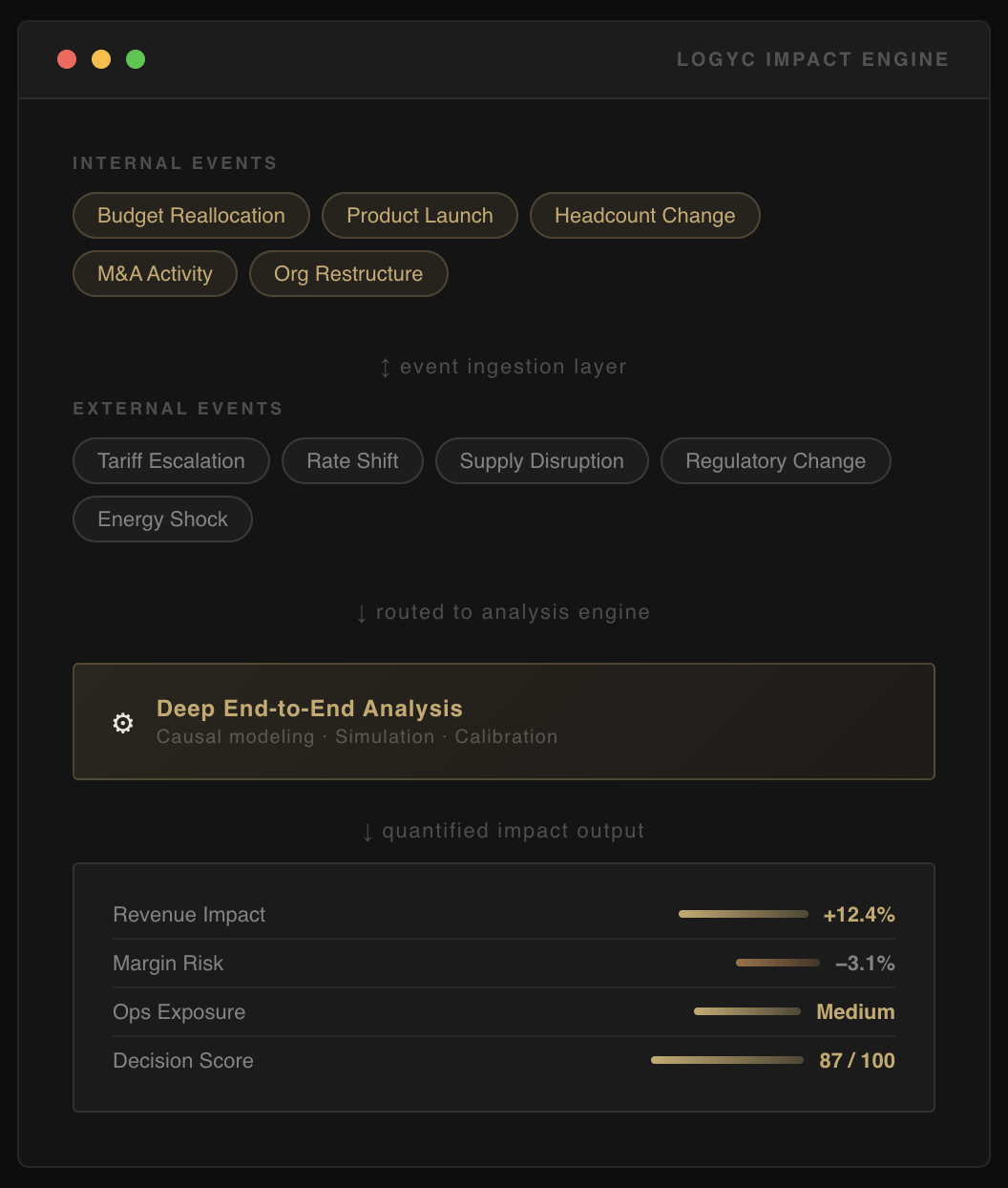
Model how decisions affect the full enterprise across value chain, operations, product, and financial layers.
Capture missing expertise from the people who know the business, not just the data that happens to exist.
Test competing paths across cost, speed, resilience, capital, and operational performance.
Compare projected outcomes with actual results and refine the model over time.
Legacy enterprise software records transactions, workflows, and historical activity. BI tools visualize what happened. Planning tools often simplify the system to fit a single forecast.
But major decisions do not happen in fragments.
A sourcing shift affects cost structure, service levels, inventory exposure, working capital, product performance, and downstream financial outcomes. A product change can reshape formulation constraints, supplier dependencies, manufacturing feasibility, margin, and risk. An external shock can move across the business faster than static systems can explain.
Logyc is designed for that reality.
It helps enterprises represent the business as an interconnected system, so leadership can evaluate how decisions and disruptions propagate before capital, time, and credibility are committed.
Show one function at a time
Depend on cleaner data than most organizations actually have
Separate operations, finance, and risk
Treat missing data as a blocker
Capture little post-decision learning
Models the business end to end
Works from available data, constraints, and expertise
Connects operational, product, and financial consequences
Simulates the value of missing information before collecting it
Improves model quality through calibration and learning
Model the business across value chain, product, operations, and finance in one environment rather than across disconnected spreadsheets and tools.
Move from executive objectives down into drivers, constraints, and dependencies, while also tracing bottom-up consequences across the system.
See how internal changes and external shocks move across sourcing, production, logistics, working capital, margin, risk, and strategic options.
Apply reusable decision logic, simulation frameworks, and model components across different use cases, business units, and environments.
Identify where critical information is missing, surface who holds relevant knowledge, and incorporate expert input into the model to reflect how the business actually works.
Estimate whether additional data is likely to materially change the decision before investing in time, systems, or collection effort.
Compare paths across service, cost, speed, resilience, working capital, capex, and other variables relevant to the decision.
Compare projected outcomes with actual results, update assumptions, refine model logic, and improve future decision quality over time.
Build connected decision context across data, assumptions, constraints, models, and expert input, so recommendations become more relevant, explainable, and decision-ready.
Connect available enterprise data, business rules, operating constraints, and expert knowledge into a working model of the system.
Identify which gaps matter, where relevant expertise lives, and whether additional data is worth collecting before action is taken.
Test decision paths, external triggers, and downside conditions across the full business rather than through one-line forecasts.
Produce decision-ready outputs with relevant trade-offs, assumptions, constraints, and implications surfaced clearly for leadership review.
Compare what was projected with what actually happened, then refine the model and recommendation logic for future decisions.
Model how decisions and disruptions move across sourcing, supplier relationships, inbound logistics, production, outbound fulfilment, and service delivery — as a connected system.
Evaluate how changes to product design, ingredient selection, or portfolio composition affect manufacturing feasibility, supplier constraints, cost structure, and customer outcomes.
Trace how operational and strategic decisions translate into margin, working capital, cash flow, and capital allocation consequences across the full planning horizon.
Model production capacity constraints, utilization trade-offs, workforce implications, and capital deployment scenarios in the context of evolving demand and strategic commitments.
Simulate how external events — tariff shifts, supply shocks, regulatory changes, rate movements, and competitive actions — propagate through the business before they become crises.
Evaluate major commitments — market entry, portfolio restructuring, M&A, network redesign — against the full system of constraints, dependencies, and second-order consequences.
Most enterprises do not have a complete or perfectly aligned operating picture. Important knowledge lives in systems, spreadsheets, habits, assumptions, and the heads of experienced people.
Logyc is built for that condition. It can start from available extracts, identify what information is missing, incorporate human expertise where it matters, and help teams judge whether collecting more data is likely to improve the decision enough to justify the effort.
That makes the platform useful earlier, not only after a major transformation program.
Logyc has been shaped with input, support, and perspective from leaders across enterprise technology, cloud infrastructure, and advanced computing. That support reflects confidence in the importance of better decision infrastructure for the modern enterprise.






Logyc is the technology and modeling foundation. CREI brings that capability into enterprise decision engagements.
Together, they combine decision infrastructure with executive-facing solutions: the platform to model complexity, and the solution layer to apply it to real high-stakes decisions.
See CREI Solutions
CREI is a strategic advisory firm that helps enterprise leadership teams navigate high-stakes capital allocation decisions, geopolitical risk, and macroeconomic transition.
If your organization is facing decisions that cut across functions, depend on incomplete information, or require a clearer view of downstream consequences, Logyc is designed for that environment.